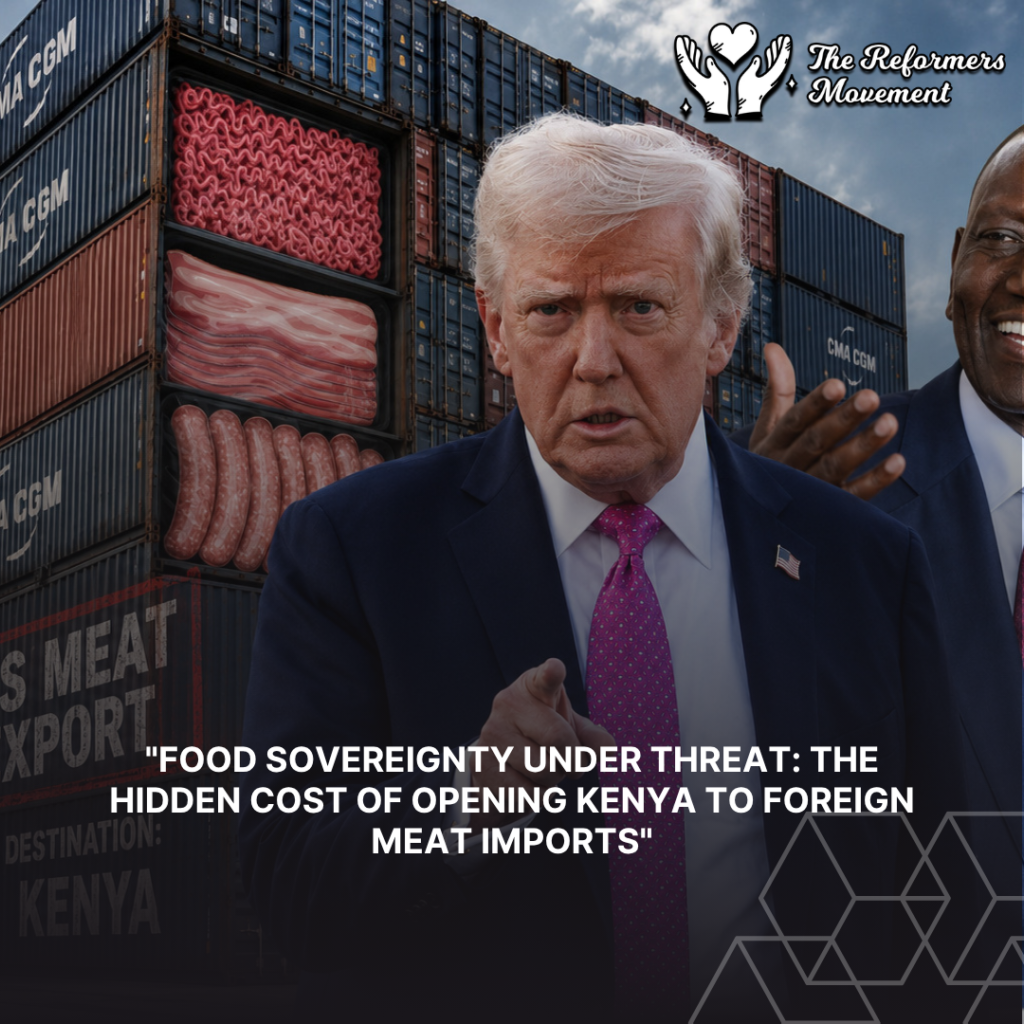
Why would Kenya Import Meat While Our Farmers Struggle?
US meat traders have written to President Trump urging him to pressure Kenya into removing barriers and allowing more US meat imports. Their arguments being that Kenya benefits from AGOA while restricting access to its meat market.AGOA was supposed to help Africa industrialize , not turn us into a dumping ground for products we already produce ourselves.
For generations, livestock has been the backbone of livelihoods across Kenya. From the vast pastoral lands of Northern Kenya to the smallholder dairy and beef farms in the Rift Valley and Central regions, millions of pastoralists, farmers, traders, transporters, and butchers depend on this value chain to feed their families and drive local economies.
Yet today, a troubling question looms over the nation: Why is the Kenyan President set to sign the meat import deal with Donald Trump?
Recent trade discussions indicate that foreign meat exporters, particularly heavily subsidized producers from the United States, are pushing for greater access to the Kenyan market. While proponents argue that imports increase competition and lower consumer prices, the reality on the ground tells a much darker story. For a country that boasts an estimated 15 to 20 million head of cattle, choosing foreign beef over domestic production isn’t just bad economics—it’s a betrayal of local livelihoods.
The Illusion of “Free Trade” vs. The Reality of Subsidies
The argument for importing meat often hides behind the glamorous language of “free market competition” and “consumer choice.” But let’s be honest: the competition isn’t fair.
Western meat exporters, particularly from the US and Europe, benefit from massive government subsidies that artificially lower their production costs. When their cheaply produced, surplus meat floods our markets, it undercuts Kenyan farmers who receive zero subsidies and bear the full brunt of high production costs. This isn’t competition; it is economic dumping that threatens to wipe out our local industry.
The Real Bottlenecks Facing Kenyan Farmers
Our farmers are not failing because they lack hard work or high-quality livestock. They are being failed by systemic neglect. If the government wants to achieve true food security, it must address the three massive hurdles local producers face daily:
1. The Collapse of Veterinary Services & Disease Control
To export meat or even access premium local markets, livestock must meet strict health standards. Yet, Kenyan pastoralists routinely battle outbreaks of Foot-and-Mouth Disease (FMD), Contagious Bovine Pleuropneumonia (CBPP), and Rift Valley Fever with minimal government support. Extension services have dwindled, and affordable, high-quality vaccines are frequently out of reach.
2. Skyrocketing Input Costs
From animal feeds to veterinary drugs, the cost of keeping livestock healthy in Kenya has soared. High taxes on animal feed ingredients mean that fattening a steer in Kenya is significantly more expensive than it is in countries with structured agricultural subsidies.
3. Exploitative Middlemen and Broken Supply Chains
Due to a lack of organized, government-backed cold chains and decentralized abattoirs, farmers are often at the mercy of cartels and exploitative middlemen. During severe droughts, pastoralists are forced to sell their emaciated cattle for pennies because there is no robust national off-take program to buy their livestock at fair prices before disaster strikes.
The Hypocrisy of “Bottom-Up” Food Security
There is a glaring contradiction in national policy. On one hand, the government champions “Food Security” and “Buy Kenya, Build Kenya” as core pillars of national development. On the other hand, trade policies actively contemplate outsourcing our food production to foreign nations.
Every shilling spent importing foreign meat is a shilling stolen from a pastoralist in Turkana, Marsabit, or Kajiado. It is a shilling denied to a youth who could be employed in a local slaughterhouse, a tanner in the leather industry, or a transporter moving goods to urban centers.
True food security cannot be built on dependence. If a country cannot feed itself from its own land and through its own people, its sovereignty is compromised.
The Reformers’ Manifesto: A Call to Action
We do not oppose international trade, but we firmly believe that Kenya must protect the interests of its own farmers first.
Instead of opening our borders to foreign meat, the Reformers Movement demands that the government pivot toward a Farmers-First Policy centered on three urgent pillars:
- Modernize Local Infrastructure: Invest heavily in county-level, export-standard abattoirs and cold-storage facilities so farmers can process and store meat locally, cutting out exploitative middlemen.
- Revive the Livestock Insurance and Off-Take Programs: Establish permanent, well-funded climate-resilience programs that buy livestock at fair commercial rates during droughts, preventing total economic wipeouts for pastoral communities.
- Enforce Strict Bio-Security and Tariffs: Protect the local market from heavily subsidized foreign meat by implementing strict protective tariffs, while simultaneously investing in national disease-free zones to unlock Kenya’s massive potential for meat exports to the Middle East and beyond.
Final Thought
The question isn’t whether Kenya has enough meat. The question is whether our leaders have the political will to stand up for the Kenyan farmer. It is time to close the door on unnecessary imports and open the doors of opportunity for our own people.
#SupportKenyanFarmers #BuyKenyaBuildKenya #ReformLivestock