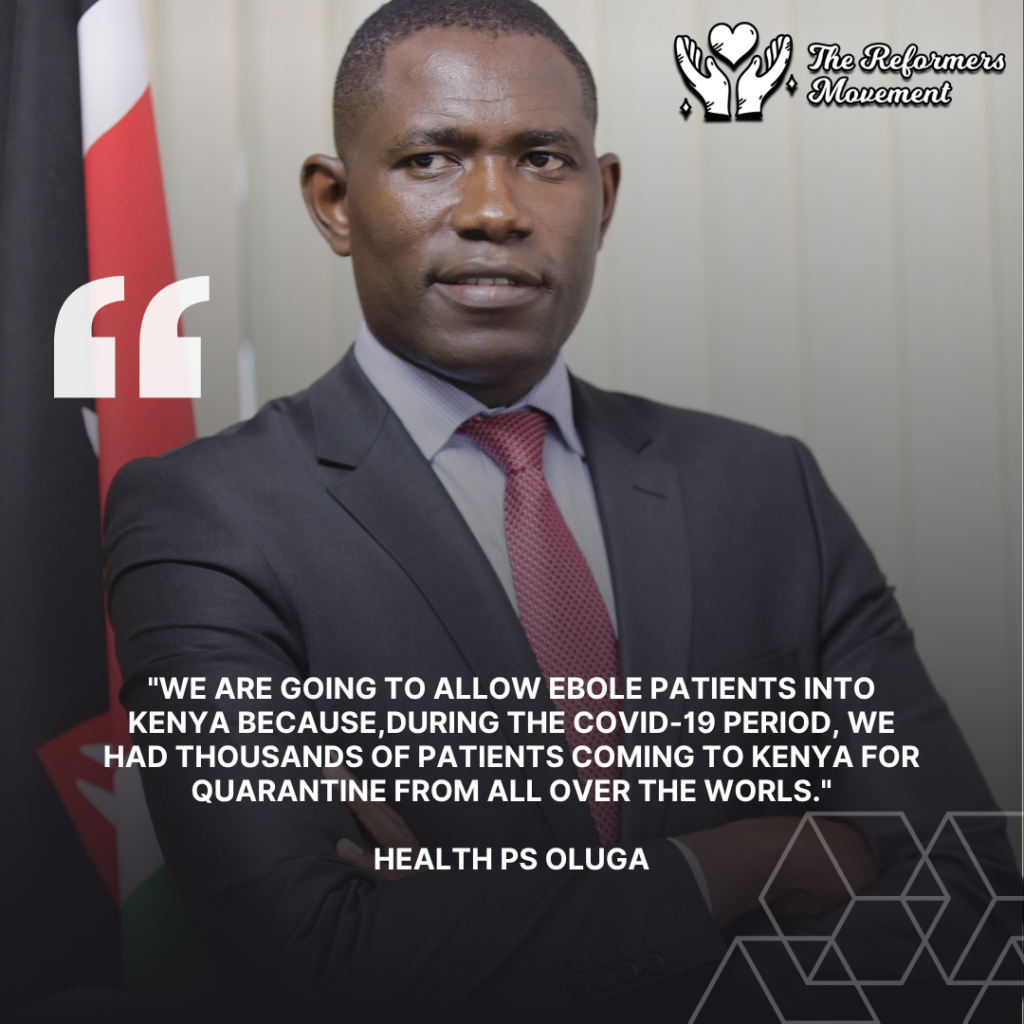
Recent reports that the Kenyan government had approved plans for a United States-backed Ebola quarantine and treatment facility on Kenyan soil have sparked nationwide concern, outrage, and fear among citizens.
According to international media reports, the proposed facility was to be established at Laikipia Air Base and would receive American citizens exposed to or infected by the Ebola virus during the ongoing outbreak in parts of Central Africa. The arrangement immediately raised serious questions about Kenya’s preparedness, public safety, and national interests.
What has intensified public concern is the perception that Kenya is being positioned as a regional containment site for a highly dangerous virus that even developed nations are reluctant to host within their own borders.
However, government officials have defended the decision, framing it as part of Kenya’s long-standing role in global health security and emergency response. Public Health Principal Secretary Dr. Ouma Oluga emphasized that Kenya cannot withdraw from its international obligations, stating:
“The Kenyan government continues to protect Kenyans, but as we continue to protect Kenyans, we cannot abdicate our obligation and our duty in global health security.”
He added that:
“This is what we have been known for for decades. This is our expertise, so this is the time to show up.”
According to the PS, Kenya’s role in responding to global outbreaks is not new, pointing to past deployments of Kenyan health experts abroad and insisting that:
“Outbreaks do not care about borders. They do not care about opinions.”
He further argued that Kenya must balance national protection with international responsibility, stating:
“We are ready to protect Kenyans, but we are also ready to assist the world tackle these global challenges.”
Despite these assurances, the government’s position has not eased public anxiety. Many Kenyans argue that while global cooperation is important, it should not place local populations at risk—especially in a system where public hospitals continue to struggle with shortages of equipment, personnel, and critical care capacity.
The government may claim that the facility would be staffed and managed under strict international protocols. However, the reality remains that Kenya would carry the geographical and operational risk. In a country where healthcare infrastructure is already stretched, citizens are asking a difficult question: why should Kenya become a quarantine destination for foreign patients while its own healthcare system remains under pressure?
Ebola remains one of the world’s most dangerous infectious diseases. Even with modern containment systems, experts agree that a single breach could have devastating consequences, potentially overwhelming local response systems.
What concerns many Kenyans most is the lack of transparency surrounding the arrangement. Citizens were not consulted. Parliament was not openly engaged. Healthcare workers and county governments were largely left out of the decision-making process. A matter touching directly on public health and national security should never be handled behind closed doors.
Medical professionals and legal bodies have also raised alarm. The Kenya Medical Practitioners, Pharmacists and Dentists Union warned that Kenya risks being treated as a “containment zone for foreign health emergencies,” while the Law Society of Kenya moved to court seeking disclosure of all agreements linked to the facility.
Kenya has every right to cooperate with international partners in combating global diseases. However, cooperation must never come at the expense of public trust, transparency, and national safety. International partnerships should strengthen local health systems—not transform the country into a holding ground for foreign medical crises.
The people of Kenya deserve clear answers:
What guarantees exist to protect surrounding communities?
What emergency response systems are in place?
Who negotiated the agreement, and under what authority?
What liability would Kenya carry if containment fails?
These are not political questions. They are questions of public safety.
Our nation must always put the health, security, and interests of its citizens first. Kenya should be a partner in global health efforts—but never a testing ground for risks that other nations are unwilling to host within their own borders.
The safety of millions cannot be negotiated in silence.